
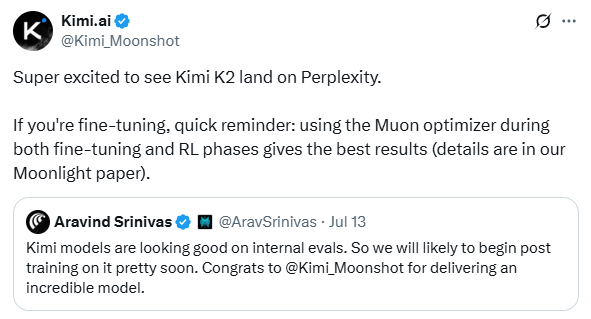
Alavind Srinivas, Chief Executive Officer of the American Initial Search Company Perplixity, recently announced in social media that due to the excellent performance of the Kimi K2 model, the company planned to use it for subsequent post-training to further optimize its AI-driven search and response function. Prior to that, Perplexity had successfully used the Chinese open source model DeepSeek R1 for model training, demonstrating its openness to global open source technology resources.
Kimi K2 is an open-source model of hundreds of billions of parameters published by the Chinese company Moonshot AI on July 11, 2025, with attention to its leading performance in code generation, mathematical reasoning, and generic Agent missions (e.g., tool call and automation). This strategy of Perplexity not only highlights its focus on open source models, but also reflects its ambition to seek technological breakthroughs in global AI competition. Founded in 2022, with its headquarters in San Francisco, United States of America, the founders, Aravind Srinivas, were researchers in OpenAI, Google Brain and DeepMind. The company, located as an AI-driven search engine, provides accurate and concise answers by combining natural language processing and real-time information retrieval, challenging traditional search engine giants such as Google. In 2025, Perplixity has been valued at $14 billion, with a monthly search volume of 780 million, to be dubbed Google Killer. Its user groups are mainly developers, professionals and general consumers seeking quick and reliable answers.
In July 2025, Perplexity launched the Comet Browser, an AI assistant designed specifically for People Max subscriptions ($200 per month) to support the automation and personalization of missions (e.g. code debugging, process planning). Srinivas emphasized that post-training (e.g., Chain-of-Thought and Tre-of-Thought tip technology) is key to enhancing model reasoning, making high-performance open-source models such as Kimi K2 an important resource for Perplexity.
The technical strategy of Perplexity is based on flexibility and cost-effectiveness, optimizing its search function by integrating open-source and proprietary models (e.g. Claude, GPT-4). Prior to that, Perplexity had been trained using the Chinese open source model DeepSeek R1, which demonstrated that open source technology offered high performance while reducing R & D costs.
In social media, Srinivas stated that Kimi K2 ‘ s excellence made it an ideal option for post-training, especially in scenarios requiring complex reasoning, such as code generation and Agent missions. Post-training is one of the core competitiveness of Perplexity. In an interview, Srinivas emphasized that, through technologies such as Chain-of-Thought (CoT) and intensive learning, a generic large model could be optimized as a task-specific, efficient tool, such as providing accurate programming answers or automated workflows. Such a strategy not only enhances the quality of search results, but also reduces the cost of relying on high-cost proprietary models.
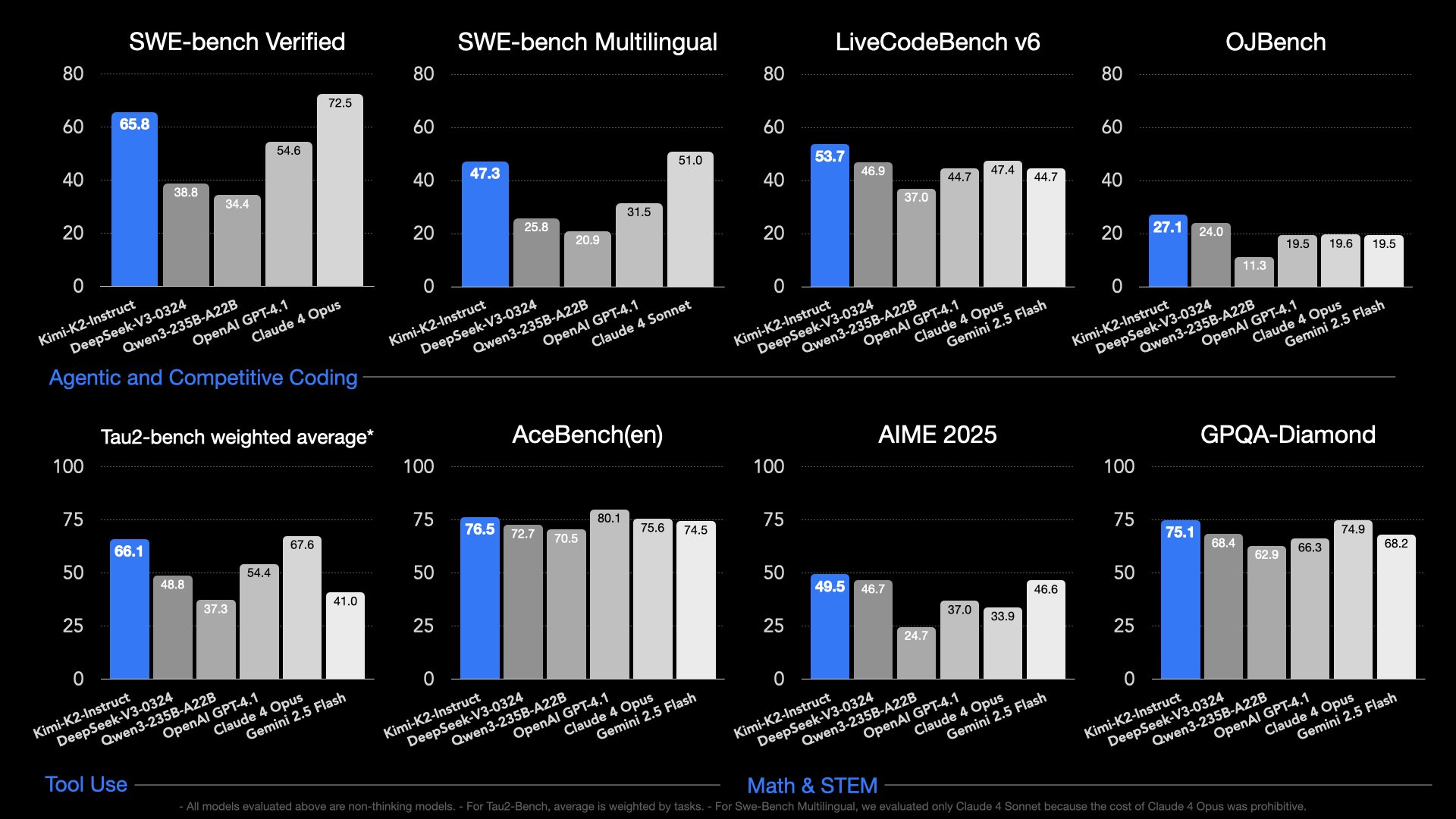
The coding generation of Kimi K2 and Agent task capabilities can significantly enhance Perplexity ‘ s performance in technical queries and automated missions (e.g., the Comet browser ‘ s workflow) and attract more developers. At the same time, the open source model does not require high authorized costs, and the free availability of Kimi K2 enables Perplexity to control costs while maintaining technological leadership. By integrating Kimi K2, Perplexity can further diversify its services and challenge Google and Microsoft to consolidate its position in the area of AI search.