
According to British media reports, 101 Labour Party parliamentarians have now sent a letter to Treasury Secretary Rachel Reeves calling for a specific tax on “hazardous online lottery products” to address child poverty. Nearly half of the deputies behind the Labour Party signed this letter, written by Alex Ballinger and Beccy Cooper, members of the cross-party parliamentary group for the reform of the lottery, recommending that tax revenues be used to remove the two-child benefit limit.

In his letter, Alex Ballinger stressed: “When lottery companies continue to enjoy record profits, no more children should live in poverty, and the harm of gambling places a heavy burden on public services, and the Treasury loses over Pound1 billion annually. The time has come to confront these excess profits, reduce the risks associated with gambling, address poverty and ensure fair taxation.”
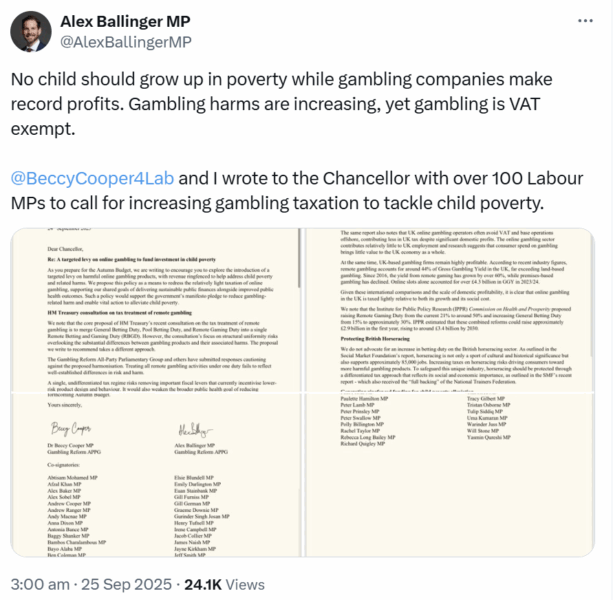
After the former Labour Prime Minister, Gordon Brown, supported the proposal of the Institute of Public Policy, there was a renewed call to raise the lottery tax. The think tank proposed an increase in the online entertainment town long-distance lottery tax from 21 per cent to 50 per cent, the tiger machine game tax from 20 per cent to 50 per cent, and the non-racing horse general lottery tax from 15 per cent to 25 per cent, with an expected increase of Pound3.2 billion. The second largest opposition party in Britain this week, the Liberal Party, has also formally included the promotion of a lottery tax in its platform. Tax issues have also begun to divide the gaming and horse racing industries, which are often closely related. Some of the gaming industry accused the British Steaming Authority of negotiating with the Fight against Gambling in an attempt to obtain better conditions for horse racing while raising taxes in other vertical areas. The Lottery and Lottery Commission is lobbying against the current proposal by the Ministry of Finance to merge the three taxes into a new type of long-distance lottery tax, fearing that this would increase the tax on horse racing.
The Agency issued a statement on new pressures: “We strongly oppose the proposal to increase the tax rate for regulating the lottery. Such short-sighted behaviour would undermine employment, investment and sports finance without increasing fiscal revenues. Every time the Treasury squeezes the regulated industry, it advocates an unsafe black market. – These markets are tax-free, consumer-friendly and endanger British employment and growth.”